eng
eng
 English
 русский
 Español
 Français
Home / News / Industry News / Type K Thermocouple Temperature Range: Limits, Accuracy, and Selection Guide

Industry News
Aug 26,2026
Type K Thermocouple Temperature Range: Limits, Accuracy, and Selection Guide
Your maintenance log tells the story better than any datasheet. The K-type thermocouple on the heat-treatment furnace read accurately for the first two weeks, then began running 30°C low at a setpoint of 1,120°C. The instrument checked out fine, the wiring was intact, and the process had not changed. That leaves one suspect: the sensor itself. Type K thermocouples are rated from −200°C to 1,260°C, and the specification is technically honest, but continuous service above roughly 1,100°C accelerates alloy degradation and calibration drift. Understanding the difference between the rated range and the practical range is what decides whether a probe lasts one season or five years.
The Type K temperature range in black and white
Type K is the most widely used industrial thermocouple because its operating envelope covers more ground than any other base-metal type. Thermocouple-grade wire is specified from −270°C to 1,260°C, although most engineers work with the more practical figure that an assembled probe can deliver: −200°C to 1,260°C (−328°F to 2,300°F). The upper number is a ceiling for brief exposure, not a license to park the sensor there indefinitely. In everyday service, keeping the process below roughly 1,100°C is the difference between stable readings and steadily growing error.
Extension-grade wire, which connects the probe to the controller, is a different product. It is matched to Type K’s thermoelectric output but only rated for −25°C to 200°C, because it never sees process heat. Running copper cable instead of K-type extension wire is a common installation mistake that silently adds a second junction and shifts every reading by an unpredictable amount.
| Wire or probe grade | Temperature range | What it is for |
|---|---|---|
| Thermocouple grade | −270°C to 1,260°C | Bare sensing wire; element inside an assembled probe |
| Practical probe range | −200°C to 1,260°C | Industrial probes; upper limit for short exposure only |
| Safe continuous range | −200°C to about 1,100°C | Long-service installations with predictable ageing |
| Extension grade | −25°C to 200°C | Cable runs from probe to controller or transmitter |
Why continuous duty tops out below the published maximum
Type K’s positive leg is a nickel-chromium alloy and its negative leg a nickel-aluminium alloy, commonly called Chromel and Alumel after their original trade names. These base metals resist oxidation far better than the copper and iron used in Types T and J, but even good alloys age at temperature. Above roughly 1,000°C, chromium in the positive wire oxidises preferentially, thinning the wire and changing its composition. The result is a slow EMF drift that makes the reading fall while the process stays constant. That is not a sudden failure; it is ageing, and it is the reason standard accuracy limits assume the sensor has not spent thousands of hours near its ceiling.
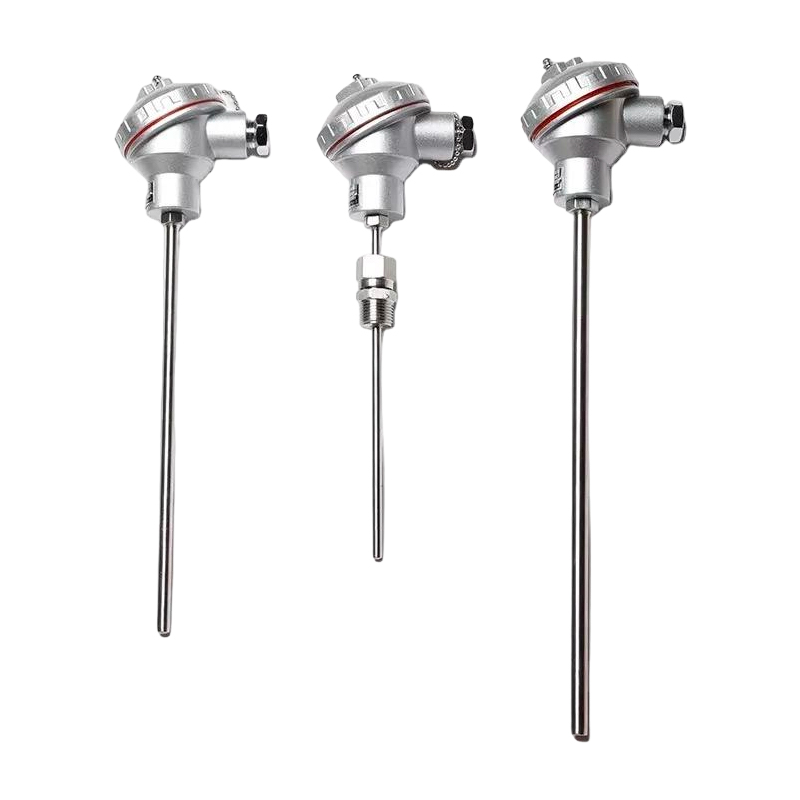
The atmosphere around the probe matters as much as the temperature. Hydrogen-rich or reducing atmospheres can cause green rot, a selective corrosion that consumes chromium and can destroy a Type K element in a fraction of its normal life. Sulphur and vacuum also attack the alloys, which is why a bare element is never a good idea in aggressive service. When a process does push toward 1,200°C, construction quality decides how long the probe survives. A 1200°C stainless steel K-type furnace probe keeps the sensing element isolated from flame and furnace atmosphere, which is the difference between drift-free operation for years and replacement every quarter.
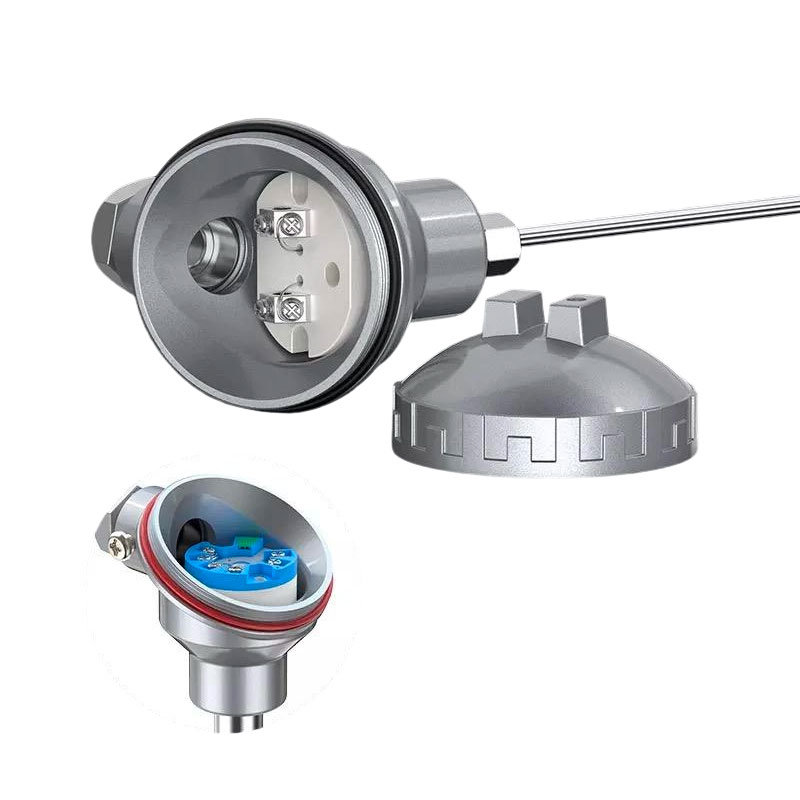 Wholesale High-temperature industrial furnace sensor Stainless steel probe 1200°Jiangsu Zhaolong Electrics Co., Ltd. is China wholesale High-temperature industrial furnace sensor Stainless steel probe 1200°C K-type th...View Product →
Accuracy, tolerance classes, and what the range really guarantees
Standard limits of error for Type K are the greater of ±2.2°C or ±0.75% of the measured temperature. IEC 60584 defines two tighter tolerance classes. Class 1 holds ±1.5°C between −40°C and 375°C, and ±0.4% from 375°C to 1,000°C. Class 2 allows ±2.5°C up to 333°C and ±0.75% above, to 1,200°C.
At high temperatures the percentage term dominates. A Class 2 probe at 1,000°C can legally read 7.5°C low, which is enough to ruin a hardening cycle if the controller is chasing a tight process window. If your process runs hot, specifying Class 1 wire and documenting the calibration is cheap insurance. Remember that the thermocouple only measures the temperature difference between the measuring junction and the connection point, so the range and accuracy you actually get also depend on cold-junction compensation inside the transmitter and on using the correct extension wire.
How the Type K range maps onto real processes
Low end: −200°C to 0°C
Type K works at cryogenic temperatures but its output sensitivity drops as it gets colder. Below about −200°C, Type T is usually preferred because it delivers a larger, more stable signal per degree. Between −50°C and 0°C, a K-type probe with proper extension wire is perfectly adequate, provided the accuracy class and cold-junction setting match the application.
Mid range: ambient to 500°C
This is the comfort zone for most K-type users: food processing, plastics machinery, HVAC, process ovens, and internal combustion tests. Exhaust-gas temperature monitoring, for example, relies on probe geometry more than on range. An L-shaped EGT K-type exhaust gas probe fits the confined space around a diesel or gas engine while keeping the junction in the gas stream, where response time matters more than absolute accuracy.
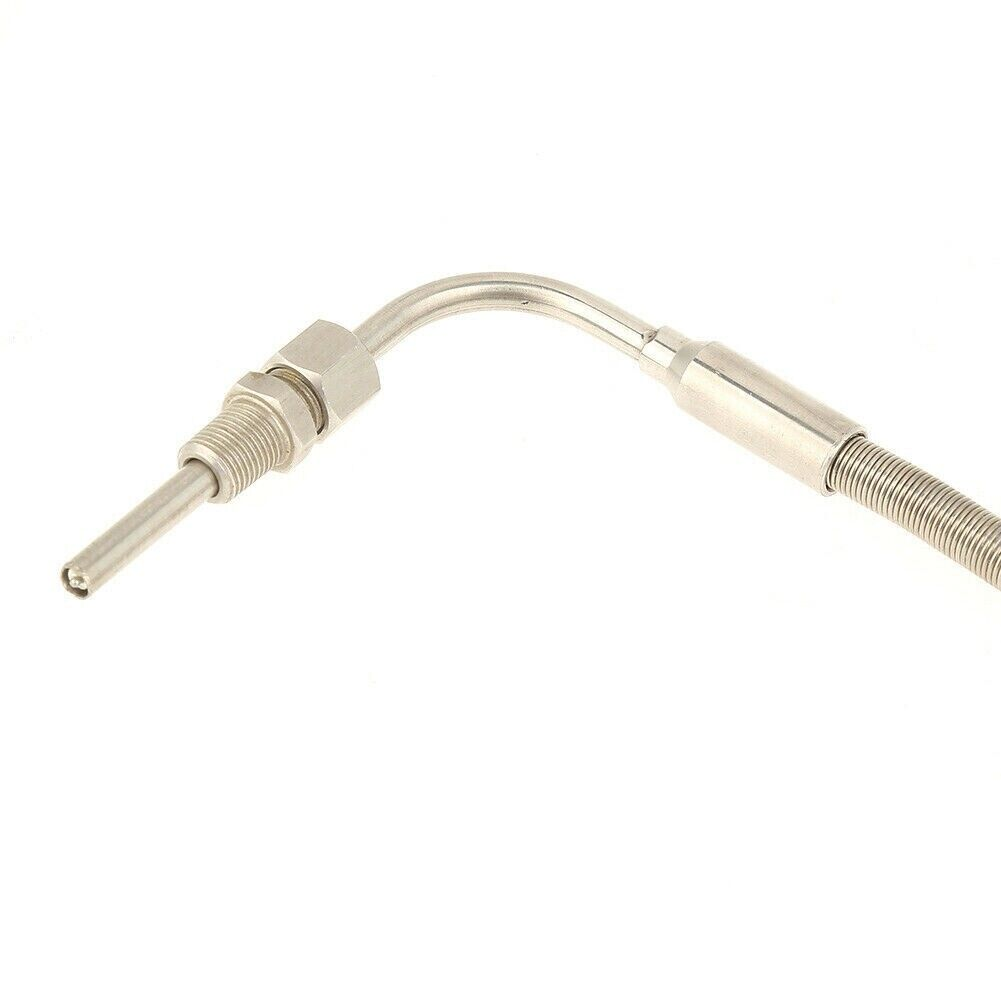 Wholesale Custom-made EGT high-temperature thermocouple K-type L-shaped exhaust Jiangsu Zhaolong Electrics Co., Ltd. is China wholesale Custom-made EGT high-temperature thermocouple K-type L-shaped exhaust probe senso...View Product →
High end: 500°C to 1,100°C
This band is where Type K earns its reputation. Fired heaters and transfer lines in petrochemical plants, ceramic kilns, and heat-treatment furnaces depend on stable readings at temperatures where most other sensors cannot survive. In abrasive duty, such as aluminium melting or scrap-fed furnaces, the element also needs mechanical protection. A wear-resistant L-type K thermocouple for furnace and aluminium service combines a hardened probe body with the same K-type element, so the sensor keeps measuring accurately while the probe shrugs off impact and slag.
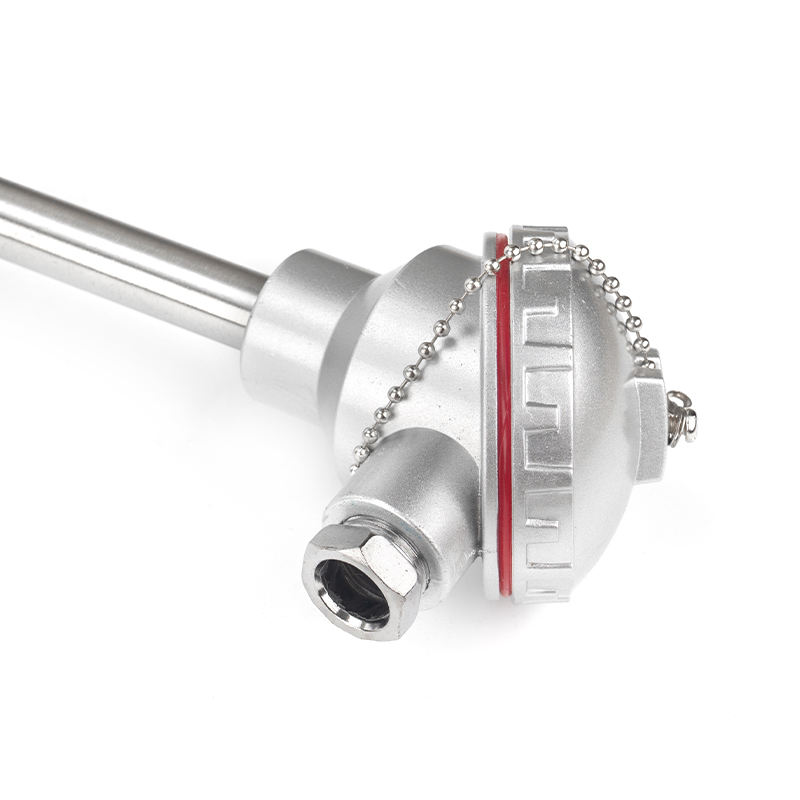 Wholesale Type K thermocouple for industrial wear-resistant L-type thermocouple Jiangsu Zhaolong Electrics Co., Ltd. is China wholesale Type K thermocouple for industrial wear-resistant L-type thermocouple furnace alu...View Product →
Above 1,100°C: proceed with a plan
Short excursions to 1,260°C are acceptable, but continuous operation above 1,100°C accelerates drift enough that a base-metal probe becomes a consumable. For a furnace that lives above 1,200°C, a platinum-rhodium or tungsten-rhenium element is the more honest engineering choice, because its calibration stays stable at temperatures that would slowly destroy Type K.
Specification decisions that determine the real range
Before you buy, check the four choices that do more to set the practical temperature limit than the wire grade itself.
- Sheath material. 304 or 316 stainless steel is fine to about 850°C. Inconel or similar high-nickel alloys extend service toward 1,100°C. Ceramic protection tubes are needed above that and in corrosive flue gases.
- Junction style. Grounded junctions respond fast but can pick up electrical noise; ungrounded junctions are slower but electrically isolated; exposed junctions are fastest and least protected. The range does not change, but the probe’s usable environment does.
- Element wire diameter. Thick wire resists oxidation longer at high temperature. A probe specified for 1,100°C continuous duty should use heavy-gauge elements, not the same wire as a 400°C oven sensor.
- Calibration and documentation. Single-point calibration is fine for indication; a certificate with Class 1 tolerances matters for process control and quality records.
Once those choices are made, the advertised Type K range becomes a practical, repeatable capability. If the application is ambiguous, a manufacturer that builds probes from wire to finished assembly, rather than a distributor reselling generic stock, is the quickest way to close the gap between datasheet and plant floor. Discuss your operating temperature range with our engineering team before you commit to a probe design.
If you remember one number from this article, make it 1,100°C. Type K’s published range is −200°C to 1,260°C, but the probe you install should be chosen for continuous duty at your process temperature, not for the theoretical maximum of the wire grade. Match the sheath to the atmosphere, the wire gauge to the temperature, the junction style to the noise environment, and the calibration class to the process window. Do that, and Type K is exactly the reliable workhorse the industry expects it to be.
Recommended Products

PRODUCT
CONTACT INFO.
-
 +86-181 1593 0076 (Amy)
-
 +86 (0)523-8376 1478
-
 [email protected]
-
 No. 80, Chang'an Road, Dainan Town, Xinghua City, Jiangsu, China
QR CODE