eng
 English
 русский
 Español
 Français
Home / News / Industry News / Industrial Wireless Temperature Sensors: Selection Guide for Process Engineers

Industry News
Sep 16,2026
Industrial Wireless Temperature Sensors: Selection Guide for Process Engineers
Imagine adding one temperature monitoring point to a running process unit. You would need to pull new cable, patch a new conduit, splice a new junction box, and probably shut down part of the line. That is why many plant engineers now consider a wireless temperature sensor as their first choice instead of the old wired route.
Why Wireless Temperature Sensors Matter in Industrial Settings
The practical case for wireless temperature measurement comes down to three measurable benefits: lower installation cost, more placement flexibility, and immediate access to process data that supports predictive maintenance.
In a refinery or chemical plant, a single wired temperature point can cost hundreds of dollars in cable, tray, conduit, and labour. If the point sits far from a marshalling cabinet, the cost multiplies. A wireless sensor eliminates most of that. The sensor is mounted, started up, and connected to an existing wireless gateway without running any new copper.
Flexibility matters just as much. On a rotary kiln, a moving belt, or a test stand, the measurement point may change. A wireless probe can be repositioned in minutes. And because wireless data can flow into a distributed control system or a web-based monitoring platform, operators can see the same temperature reading in the control room and on a mobile device.
The data from a wireless point also makes condition monitoring easier. Process engineers can compare a temperature trend with pump vibration data, motor current, or product quality results. A slow drift in temperature can indicate fouling in a heat exchanger, degradation of insulation, or the beginning of a bearing failure. That trend is difficult to capture with a manual temperature check, but it is exactly what a connected sensor captures automatically.
| Evaluation area | Wired temperature sensing | Wireless temperature sensing |
|---|---|---|
| Installation cost | High - requires cable, conduit, and manpower | Low - probe plus transmitter, no cable |
| Placement flexibility | Limited by cable route and cable length | Sensor can be relocated or added quickly |
| Expansion in running plant | Often needs process shutdown | Usually possible during normal operation |
| Signal availability | Local DCS or PLC only | Wireless gateway, DCS, SCADA, or cloud platform |
Key Performance Criteria for Selecting a Wireless Temperature Sensor
Selecting the right industrial wireless temperature sensor starts with the sensing element, not the radio. The probe type, material, and accuracy class determine whether the unit can serve the process reliably.
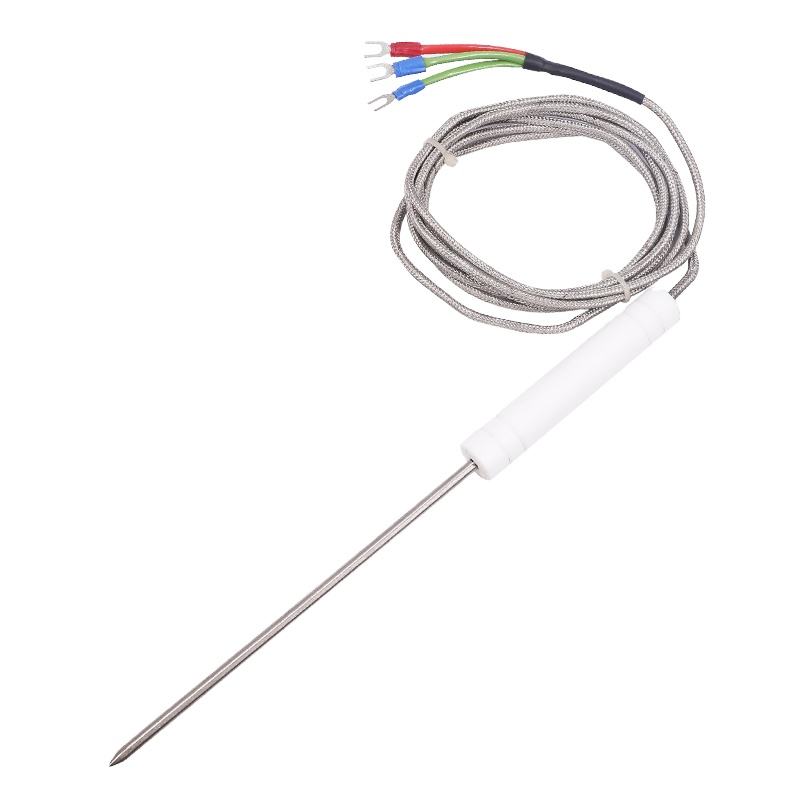
For a 1200 °C furnace, a stainless-steel K-type thermocouple probe with a ceramic protection tube works. For a 1800 °C kiln, a platinum-rhodium thermocouple is better. For a food machine, a stainless-steel PT100 probe with a sealed, hygienic connection is required. Each application has its own temperature range, response time, and corrosion environment.
Accuracy is usually expressed as Class A or Class B for PT100 resistance temperature detectors. Class A is around ±0.15 °C at 0 °C, and Class B is around ±0.30 °C. For thermocouples, the tolerance classes follow IEC 60584 and depend on the thermocouple type.
The wireless side has its own selection factors. Industrial protocols such as WirelessHART and ISA100.11a offer robust mesh networking for process plants. Long-range LoRa and NB-IoT suit remote storage tanks and outdoor equipment. Battery life is another key: a sensor that samples once per minute will run for years, while one that samples every few seconds needs a larger battery or a duty-cycled power design.
The relationship between sampling rate and battery life is often misunderstood. A sensor that reports once per minute may run for six years on a standard battery. The same sensor reporting every ten seconds could drain the battery in eighteen months. For most process monitoring, a slower update rate is perfectly adequate. For control loops that need fast response, keep the wired measurement in place and use the wireless point as a monitoring input.
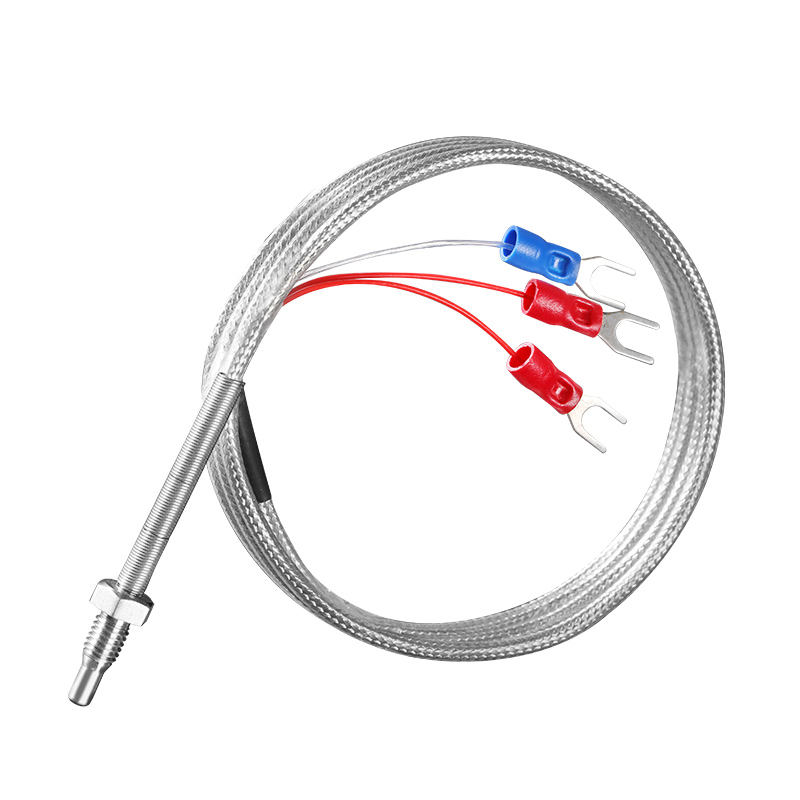
 Compact Industrial Temperature Sensor with Stainless Steel Screw Mount and PT100K ProbeThis industrial-grade temperature sensor features a stainless steel screw mount and PT100K probe, designed for reliable measurement in process monitoring where a permanent installation is required. It complements wireless systems by providing a stable wired measurement point.View Product →
Integrating Wireless Temperature Monitoring with Existing Instrumentation
Wireless temperature sensors do not have to replace your existing control architecture. They typically fit into it as a new source of process variables.
A temperature transmitter conditions the signal from the sensor. In a wireless implementation, the same transmitter function is built into the wireless head or separate enclosure. The transmitter's output can run directly to a gateway that translates wireless data into 4-20 mA, HART, Modbus, or Ethernet to match the control system.
For plants that already use wired temperature transmitters, the transition to wireless often involves installing a second measurement point at the same process location, one wired and one wireless. The wireless reading acts as a cross-check or as a redundant input for critical loops. For new installations, a wireless transmitter can supply the primary signal without the cost of a full new cable tray.
Temperature controllers also play a role. A wireless temperature input can be used as a feedback signal for a PID controller if the control system supports a wireless gateway. In practice, many plants use the wireless sensor as a supervisory input and keep the main control loop wired. This hybrid approach gives the best of both worlds: low installation cost for additional data and high reliability for critical loops.
 Fully Isolated Integrated Temperature TransmitterThis integrated transmitter accepts inputs from various RTDs and thermocouples, providing an isolated analog output suitable for integration into control systems. It enables the use of wireless sensor signals as supervisory inputs while maintaining wired loop reliability.View Product →
Industry Applications and Practical Considerations
In a petrochemical plant, wireless temperature points are common on storage tanks, transfer lines, and flare systems. They are also useful for temporary process studies, because the crew can add a temporary sensor without shutting down the unit. See how the company supports petrochemical industry instrumentation for more details.
In the food machinery sector, the probe must follow hygienic standards. A hand-held needle probe or a sealed PT100 probe with a sanitary cap fits that duty. The sensor body needs to be easy to clean and resistant to washdown water. You can learn more about the company's temperature sensors for food machinery.
Chemical and daily chemical plants often face corrosive atmospheres. A 316 stainless steel probe with a PTFE coating or a ceramic protection tube extends service life. The instrument protection rating must be at least IP65, and explosion-proof housing is necessary if the sensor is mounted in a classified hazardous area.
Sourcing Tips for Procurement and Engineering Teams
When you send an enquiry for industrial wireless temperature sensors, make sure you include the following information:
- Temperature range and expected normal process temperature
- Required accuracy class for the sensor element
- Process connection type, probe length, and sheath material
- Environment: presence of moisture, vibration, corrosion, or high ambient temperature
- Existing automation system and the desired protocol for the wireless signal
- Certification requirements such as ATEX, IECEx, CE, or local explosion-proof approval
Working with a manufacturer that can supply custom probe designs shortens the selection cycle. A factory-direct supplier provides a clearer view of material quality and tolerances. Also ask about the wireless transmitter source, battery replacement, and how the device is commissioned to the gateway.
Wireless temperature monitoring is no longer a niche concept. It is a straightforward way to add measurement points, cut installation labour, and make plant data more accessible. The key decision is not whether to use wireless, but how to choose the right probe, the right transmitter, and the right radio link for the process.
Recommended Products

PRODUCT
CONTACT INFO.
-
 +86-181 1593 0076 (Amy)
-
 +86 (0)523-8376 1478
-
 [email protected]
-
 No. 80, Chang'an Road, Dainan Town, Xinghua City, Jiangsu, China
QR CODE