eng
 English
 русский
 Español
 Français
Home / News / Industry News / How Does a Resistance Temperature Detector Work? | RTD Explained Guide

Industry News
Sep 30,2026
How Does a Resistance Temperature Detector Work? | RTD Explained Guide
Resistance temperature detectors, or RTDs, are among the most reliable temperature sensors used in industrial automation. As a manufacturer that has designed and built temperature sensors and temperature control instruments for years, we often hear the same question from process engineers and maintenance teams: how does a resistance temperature detector work? The answer is surprisingly straightforward, and once you understand the principle, selecting, installing, and troubleshooting an RTD becomes much easier.
What Is a Resistance Temperature Detector?
An RTD is a temperature sensor that measures temperature through the change in electrical resistance of a metal sensing element. The name is a perfect description: a resistance temperature detector detects temperature by detecting resistance. The sensing element is almost always platinum, which is why the most common RTD designations are PT100, PT500, and PT1000. In each case, the number indicates the nominal resistance of the element at 0°C.
Platinum is preferred because its resistance increases with temperature in a highly repeatable, nearly linear way. It also resists corrosion and remains stable over many thermal cycles. Industrial RTDs built around platinum elements are standardized in IEC 60751, which defines nominal resistance values, temperature coefficients, and tolerance classes such as Class A and Class B.
| RTD Type | Resistance at 0°C | Resistance at 100°C |
|---|---|---|
| PT100 | 100 Ω | 138.5 Ω |
| PT500 | 500 Ω | 692.5 Ω |
| PT1000 | 1,000 Ω | 1,385 Ω |
How Does a Resistance Temperature Detector Work?
The operating principle of an RTD is based on a fundamental property of metals: electrical resistance rises as temperature rises. When a metal is heated, its crystal lattice gains thermal energy and the atoms vibrate more vigorously. These vibrations scatter the electrons that carry current, making it harder for electricity to flow. The measurable result is an increase in resistance that is directly related to temperature.
In an industrial RTD probe, the sensing element is connected by lead wires to a temperature transmitter, controller, or panel meter. The instrument sends a small, constant excitation current through the element and measures the voltage across it. The resistance is then calculated using Ohm's law, R = V/I. Because the current is fixed, the measured voltage becomes a direct indication of resistance, which the instrument converts into a temperature reading using the platinum calibration curve.
For a PT100 that follows IEC 60751, the temperature coefficient of resistance is 0.00385 Ω/Ω/°C. In practical terms, the resistance of a PT100 element increases by roughly 0.385 Ω for every degree Celsius. This predictable and stable relationship is the reason RTDs achieve the accuracy and long-term drift resistance that thermocouples often cannot match.
Thin-Film and Wire-Wound RTD Elements
The construction of the sensing element influences accuracy, response time, and cost. Two designs dominate the market: wire-wound and thin-film.
A wire-wound element is made by winding a very fine platinum wire around a ceramic or glass mandrel and then sealing it. Wire-wound RTDs offer excellent stability and are the classic choice for precision thermometry and laboratory reference work. A thin-film element, by contrast, is produced by depositing a microscopically thin platinum layer onto a ceramic substrate, then laser-trimming it to the target resistance. Thin-film RTDs are smaller, respond faster, resist vibration well, and are more economical to manufacture, making them the standard for general industrial applications.
| Characteristic | Wire-Wound | Thin-Film |
|---|---|---|
| Stability | Excellent | Very good |
| Accuracy | Higher | Good |
| Response time | Slower | Faster |
| Vibration resistance | Fair | Excellent |
| Typical cost | Higher | Lower |
| Common use | Precision and laboratory | General industrial |
Two-Wire, Three-Wire, and Four-Wire RTD Wiring
An RTD is a passive sensor, which means it must be excited by an external current before a reading can be taken. The lead wires that connect the sensing element to the instrument also have resistance, and this resistance can corrupt the temperature reading if it is not managed carefully.
A two-wire RTD is the simplest configuration: one wire supplies current and the same two wires complete the loop. The instrument sees not only the element resistance but also the resistance of both lead wires, so the reading drifts higher as lead length increases. Two-wire RTDs are acceptable for short local connections with moderate accuracy requirements.
A three-wire RTD, the most common configuration in industry, separates the current path from the sense path. Because no meaningful current flows in the sense wire, the resistance of the lead wires can be measured and subtracted, effectively eliminating lead resistance errors. A four-wire RTD goes one step further with completely independent current and sense pairs, providing the highest accuracy of all. Four-wire connections are used when the measurement must be free of any lead resistance influence.
| Configuration | Lead Resistance Compensation | Typical Accuracy | Common Application |
|---|---|---|---|
| 2-wire | Not compensated | Moderate | Short, local wiring |
| 3-wire | Compensated | Good | Industrial standard |
| 4-wire | Eliminated | Excellent | Precision measurement |
Common Industrial Applications
Because a resistance temperature detector offers excellent accuracy, stability, and linearity over a wide industrial range, it appears in almost every process industry. We supply RTD probes to plants that handle everything from refined petroleum to packaged food, and the typical applications are much the same around the world.
- Petrochemical and natural gas plants: pipeline, storage tank, and reactor temperature monitoring.
- Chemical and daily chemical industries: process vessels and mixing tanks where stable measurement is critical.
- Food machinery: hygienic product and process temperature measurement in wash-down environments.
- Analytical instruments: compact RTD elements that provide a stable temperature reference inside analysers.
- Industrial furnaces and heat-treatment equipment: RTDs for lower-temperature stages where thermocouples are less accurate.
In petrochemical plants, for instance, RTDs monitor pipeline and reactor temperatures where a small deviation can affect product quality or safety. Many operators in the petrochemical industry choose fixed-thread RTDs that screw directly into existing process connections, which simplifies installation and maintenance.
In the food machinery sector, probes must combine accuracy with hygienic design. Stainless steel food-grade RTD probes with smooth surfaces are used to measure product and process temperatures while withstanding regular cleaning. We manufacture PT1000, PT100, and NTC probes with food-grade stainless steel tips for exactly these environments.
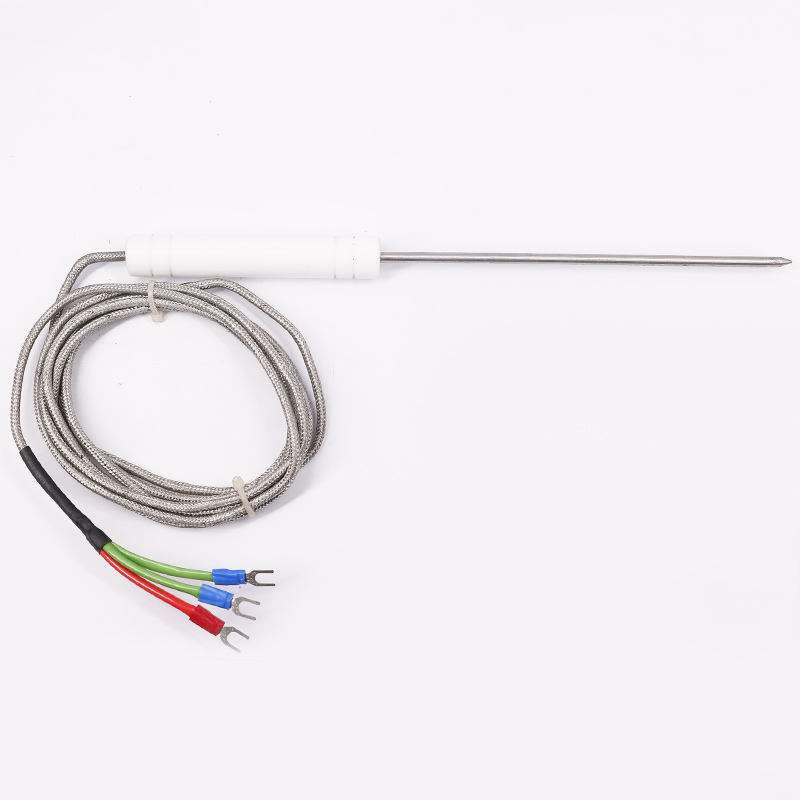 Stainless Steel Food-Grade RTD Probe for Meat, Barbecues, and OvensThis food-grade probe combines PT1000, PT100, or NTC elements with smooth stainless steel tips, making it suitable for hygienic food machinery where accuracy and cleanability are required. Its customizable length and wire options support process matching.View Product →
Choosing the Right RTD for Your Process
When selecting an RTD probe, the operating principle alone is rarely enough. The sensor must be matched to the process: temperature range, tolerance class, sheath material, probe length, and mounting style all determine how well the sensor performs.
Tolerance class is one of the most important specifications. A Class A RTD element offers better accuracy than a standard Class B element, and this premium is often worth the small extra cost when product quality or process efficiency depends on precise temperatures. At Jiangsu Zhaolong Electrics, we manufacture a factory-direct PT100 RTD with a Class A platinum element inside a 316 stainless steel sheath, giving it a practical operating range of 200°C to 450°C for demanding industrial service.
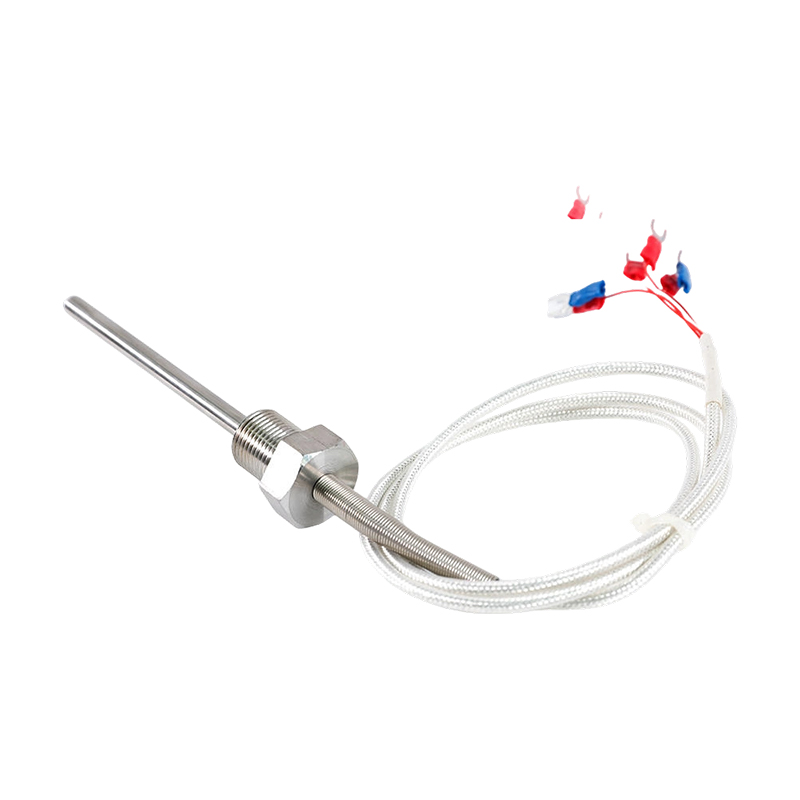 Class A PT100 RTD Probe with 316 Stainless Steel and 1/2" ThreadFeaturing a Class A platinum element and 316 stainless steel sheath, this threaded probe operates from -200°C to 450°C. The fixed thread enables direct installation into tanks or pipelines, offering precision and easy mounting for industrial temperature measurement.View Product →
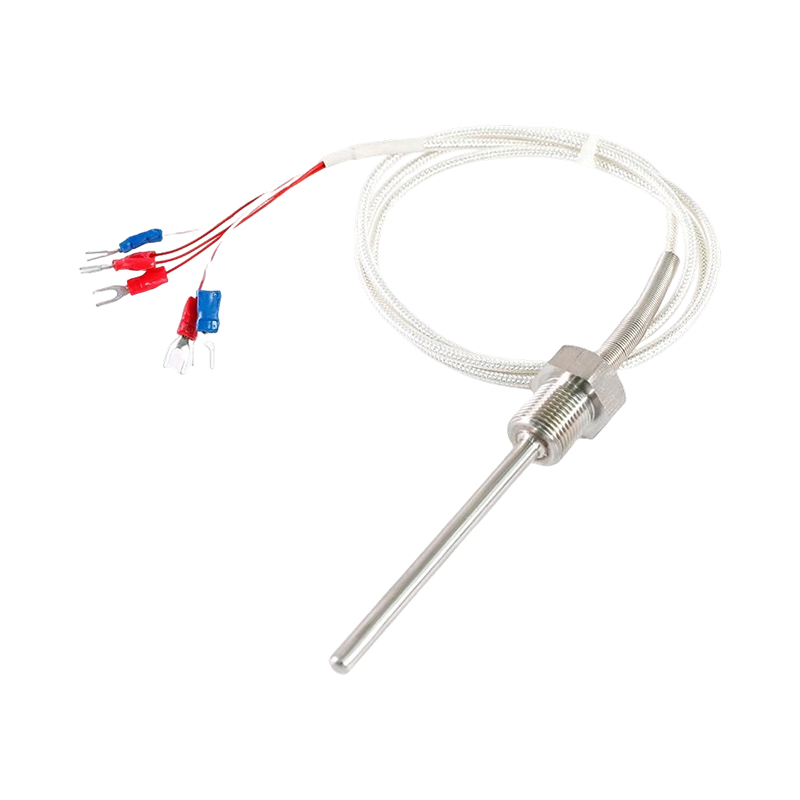
The mounting style matters almost as much as the element. A fixed-thread thermal resistance probe can be installed directly into a threaded boss on a tank, pipeline, or machine, creating a leak-tight connection without extra clamps or brackets. This style is especially popular among plant maintenance engineers because it reduces installation time and keeps the sensing tip exactly where it should be.
 Immovable Thread Type Thermal Resistance Probe (WZPK-201)This fixed-thread thermal resistance probe offers direct leak-tight installation into threaded bosses, reducing assembly time. With a -200°C to 420°C range and fast response, it suits plant maintenance applications where reliable mounting and accurate sensing are key.View Product →
If you are replacing an existing RTD in your plant, matching these parameters is essential. Our engineering team can also provide custom probes, non-standard lengths, and special mounting threads to fit legacy equipment, a service we have refined through years of supplying temperature sensors to global customers.
Conclusion
Understanding how a resistance temperature detector works begins with a simple fact: metals change resistance with temperature, and platinum does so in a highly repeatable way. From the PT100 element at the heart of the probe to the three-wire or four-wire connection that carries its signal, every part of the RTD is designed to turn a physical change into a precise, reliable temperature reading.
If you would like help selecting an RTD for your process, or if you need a custom temperature sensor for an unusual installation, our engineers are ready to assist. Contact our team and we will be glad to discuss the right solution for your application.
Recommended Products

PRODUCT
CONTACT INFO.
-
 +86-181 1593 0076 (Amy)
-
 +86 (0)523-8376 1478
-
 [email protected]
-
 No. 80, Chang'an Road, Dainan Town, Xinghua City, Jiangsu, China
QR CODE